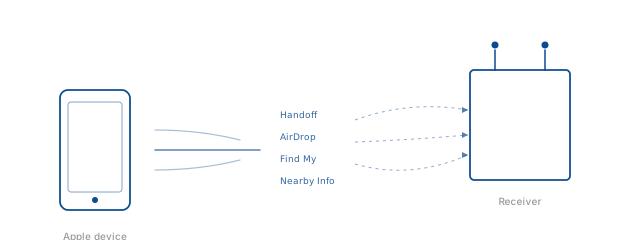
Apple Continuity is the proprietary Apple technology that allows Apple devices to work together. For communication, the Continuity protocol uses Bluetooth and Wi-Fi. The Bluetooth Framework can capture and decode Apple Continuity Bluetooth LE advertisement packets.
Continuity messages
Each Continuity advertisement packet contains one or more Continuity messages. To test the decoding, use the Beacons sample
application from the Bluetooth Framework package. The framework can decode the following messages.
| Message | Description |
|---|---|
| AirDrop | Allows users to share files over Wi-Fi and Bluetooth without needing both devices on the same Wi-Fi network. |
| AirPlay Source | Sent when a user opens the menu to select a device to play media from when multiple sources are available. |
| AirPlay Target | Sent by AirPlay-compatible devices to advertise their presence to Apple devices actively seeking to send media. |
| AirPrint | Enables printing from iOS and macOS devices without installing additional software if the printer supports AirPrint. |
| Find My | Broadcast by Apple devices marked as lost or without internet connectivity. The message carries an elliptic-curve public key. Nearby internet-connected Apple devices relay an encrypted location report to Apple servers, readable only by the device owner. |
| Handoff | Enables starting a task on one iOS or macOS device and finishing it on another. Supported by Calendar, Contacts, Mail, Maps, Messages, Notes, Reminders, Safari, Pages, Numbers, Keynote, and some third-party apps. |
| Hey Siri | Emitted by a device when Siri is activated. Includes a perceptual hash of the voice command. |
| HomeKit | Continuously broadcast by HomeKit-compatible devices, part of Apple's smart home framework. |
| Magic Switch | Apple Watch-specific. Sent when a user is wearing an Apple Watch that has lost its connection to its paired iPhone while its screen is on. |
| Nearby Action | Sent to inform nearby devices of a change in device state, such as joining a Wi-Fi network or the initial setup of an iOS device. |
| Nearby Info | Broadcasts the usage state of an iOS device to nearby devices. Sent continuously in modern iOS versions and can be used to passively determine general usage states such as phone locked, active user, or driving a vehicle. |
| Proximity Pairing | Used to pair AirPods and iOS devices. These messages carry unencrypted status, model, and color of the audio device, along with power and charging status. |
| Tethering Source | Broadcast in response to a Tethering Target message from another device on the same iCloud account. Carries battery life and cellular service type and quality of the hotspot device. |
| Tethering Target | Broadcast to elicit a response from a device that can act as a hotspot. Typically triggered when a user opens the list of available Wi-Fi networks on a MacBook. A hotspot-capable device on the same iCloud account replies with a Tethering Source message. |
Why decode Continuity messages
Apple devices broadcast Continuity messages continuously and without authentication. Any BLE scanner within radio range receives them. This has two consequences: it makes the messages trivially observable, and it makes them a rich source of information about the physical environment that no other signal provides so easily on Windows.
Once the raw packets are decoded into structured messages, an application can reason about what Apple hardware is nearby, what it is doing, and how it is configured. That is useful well beyond Apple's own ecosystem.
Device presence and proximity
Every Apple device periodically emits Continuity advertisements. Decoding them turns any Windows machine into a passive detector of nearby Apple hardware. Combined with RSSI, an application can estimate proximity without asking the user to install anything or to grant permissions. This is the foundation for room-level presence detection, occupancy analytics for meeting rooms, retail footfall counters, or triggering automations when a specific person approaches a workstation.
Because the advertisements carry identifying information, the same signal can be used to distinguish between device classes. An AirPods case, an iPhone, an Apple Watch, and a MacBook all broadcast with different message types, which means an application can count devices per category without identifying individual users.
Device state and activity
Continuity messages leak device state. Nearby Info in particular reports whether the phone is locked, whether the screen is on, whether the user is actively interacting with it, and even whether the user is currently driving. Handoff indicates whether a user is currently working on a specific application on a specific device. Hey Siri indicates that a voice command has just been issued.
For UX designers and product teams, this information is normally invisible. It enables context-aware behavior: pausing a desktop notification when the user's phone is already unlocked, delaying a phone call when the user is driving, or showing a different interface when the user has just transitioned a task between devices. Because decoding happens passively on the Windows side, no code runs on the Apple device, and no permission needs to be requested from the user.
AirDrop and privacy analysis
AirDrop advertisements contain a truncated hash derived from the user's Apple ID and email addresses. The hash rotates periodically, and it cannot be reversed, but its presence and rotation patterns are themselves informative. Security researchers use AirDrop advertisements to study how Apple devices expose identifying information in public spaces, how reliably the hash rotation works across iOS versions, and what can be inferred about a device owner from the broadcast alone.
For enterprise deployments, the same techniques support compliance and audit tasks. A managed Windows machine can detect which Apple devices are broadcasting in a controlled area and produce evidence for internal security reviews without requiring cooperation from the device owners.
Audio device discovery
Proximity Pairing messages contain unencrypted details about nearby AirPods and Beats headphones: model identifier, color, current battery level of each earbud and the case, and charging state. Most Windows utilities ignore these messages entirely because the standard Bluetooth stack treats AirPods as generic A2DP devices.
Decoding the Proximity Pairing message closes that gap. A Windows application can display the battery level of AirPods with the same accuracy as macOS does, warn the user before the battery dies mid-call, or automatically switch audio endpoints when a specific pair of headphones is detected nearby. The same applies to other audio devices that use the Proximity Pairing protocol.
Security research and forensics
Continuity is a large, undocumented attack surface. It is used by every modern Apple device, it runs continuously, and its contents vary between iOS and macOS versions. Security researchers use decoded Continuity traffic to study how Apple devices behave on the radio level: when they transmit, what they transmit, how the addresses rotate, and how much of the payload is predictable.
On the defensive side, decoding allows building detection systems that recognize specific Apple device classes in a physical space. Airports, hospitals, and government buildings can passively inventory which Apple devices are operating in restricted areas, correlate that with access control logs, and produce forensic evidence after an incident, all without touching any of the devices.
Integration with non-Apple software
Apple does not provide a public API for reading Continuity advertisements. This means that on Windows, the only way to consume the information is to capture and decode the raw BLE traffic directly. The Bluetooth Framework fills that gap by exposing a decoded, structured representation of Continuity messages to any application that uses the framework.
The practical effect is that non-Apple software can participate in environments dominated by Apple hardware. A Windows-based conference room system can react to a user's iPhone arriving. A retail Windows application can distinguish a customer who just opened AirDrop from one who is simply walking past. An access control system can use Proximity Pairing as a soft factor in authentication. None of this requires Apple cooperation, an Apple developer account, or an iOS application.
Frequently asked questions
- What is Apple Continuity?
- Apple Continuity is a proprietary Apple technology that allows Apple devices to work together using Bluetooth and Wi-Fi.
- Which Continuity messages can the Bluetooth Framework decode?
- The Bluetooth Framework can decode AirDrop, AirPlay Source and Target, AirPrint, Find My, Handoff, Hey Siri, HomeKit, Magic Switch, Nearby Action, Nearby Info, Proximity Pairing, and Tethering Source and Target messages.
- How to capture Apple Continuity BLE advertisements?
- Use the
Beaconssample application from the Bluetooth Framework package. It captures and decodes Apple Continuity BLE advertisement packets. - Is it legal to decode Apple Continuity advertisements?
- The advertisements are broadcast unencrypted over license-free radio bands and are received passively. Decoding them does not require modifying or accessing any Apple device. Laws about radio monitoring vary by country, and any use of the decoded data should comply with local privacy regulations.